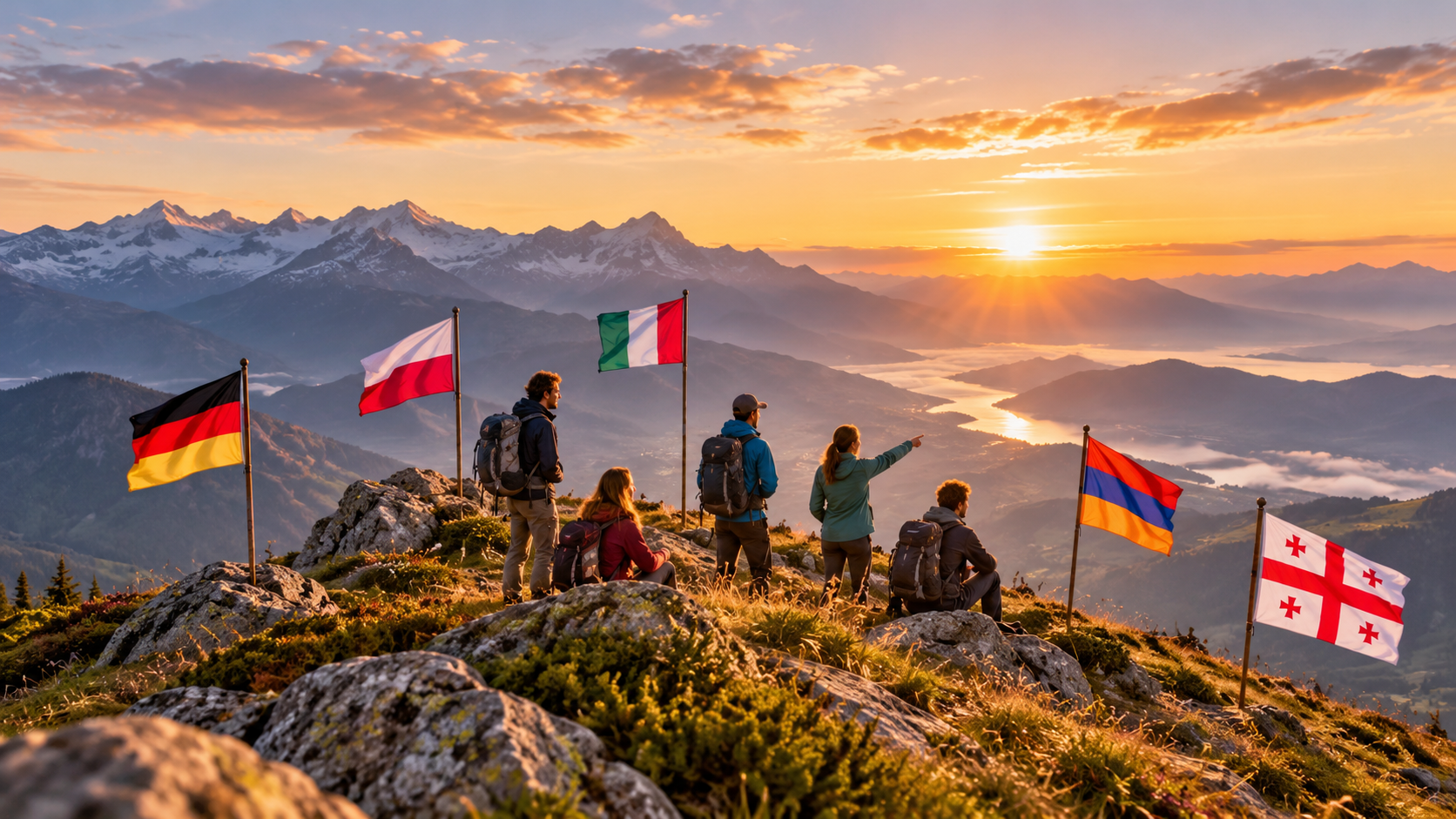
Different cities. Different cultures. Different experiences. One shared question: How can the places around us become spaces for learning?
Outdoor education is often associated with forests, mountains, adventure programmes and activities in natural landscapes.
Yet learning outside the classroom can take many different forms.
It might happen in a public square in Germany, a neighbourhood in Poland, a historic street in Italy, an urban park in Armenia or a community space in Georgia.
Each location offers its own opportunities and challenges.
Through the Concrete Jungle project, partners from Germany, Poland, Italy, Armenia and Georgia are connected by a shared interest in exploring outdoor education through an urban lens.
Their different geographical, social and cultural contexts provide an opportunity to ask how educational methods can be adapted to diverse environments.
The most interesting question may not be which country has the best approach.
Instead, it is what we can learn when we compare different experiences, share ideas and recognise that no single method works everywhere.
Outdoor Education Beyond the Traditional Classroom
Outdoor education is not simply about moving a lesson outside.
At its best, it encourages participants to learn through direct experience, observation, cooperation and reflection.
The surrounding environment becomes part of the learning process.
In a city, participants might investigate how public spaces are designed, how communities interact, where nature survives and what makes a neighbourhood welcoming.
They might use photography, mapping, storytelling, creative challenges or group discussions.
The same educational activity can produce different outcomes depending on where it takes place.
A public-space observation exercise in a historic city centre may raise questions about heritage and tourism.
In a residential neighbourhood, participants may focus on accessibility, community relationships or everyday services.
In an area undergoing redevelopment, conversations might turn towards environmental change, belonging and who gets to influence planning decisions.
These differences are not obstacles to learning.
They are part of what makes urban outdoor education valuable.
Germany: Exploring the Relationships Between People and Public Space
The Concrete Jungle project connects with Potsdam and Berlin, two cities that offer contrasting possibilities for urban exploration.
Their streets, public spaces, green areas and built environments can provide starting points for educational questions.
How do people share public spaces?
What makes a park or square inviting?
How does transport influence our experience of a neighbourhood?
How do historical buildings and contemporary developments exist alongside one another?
An educational activity in these settings could ask participants to compare different kinds of public space.
They might observe a busy street, a residential area and a green space, then discuss how the design of each location influences behaviour.
The learning opportunity is not simply to describe the city.
It is to consider how planning decisions affect everyday experiences and how public spaces might better serve different communities.
Poland: Discovering Learning Opportunities in Everyday Urban Life
Lublin, one of the project’s host cities, offers another setting in which educators can explore the relationship between people, place and community.
Urban outdoor education does not require famous landmarks or unusual destinations.
Sometimes the most meaningful activities happen in ordinary neighbourhoods.
A local square, bus stop, courtyard or pedestrian street can become a place for observation and discussion.
Participants could map places where people meet, identify barriers to accessibility or explore how different generations use shared spaces.
They might also examine the relationship between historic areas and contemporary urban life.
Such activities can encourage young people to recognise that their own everyday experiences are worth investigating.
The familiar city becomes a place of discovery rather than merely somewhere to travel through.
Italy: Connecting Landscape, Heritage and Community
The project’s Italian host city, Feltre, offers a different context for thinking about urban outdoor education.
Its setting invites questions about the relationship between built environments, surrounding landscapes and local identity.
How does a town connect with the natural environment around it?
How do public spaces reflect local history?
Where do residents meet, interact and participate in community life?
An educational activity might ask participants to create a visual map showing connections between streets, green spaces, buildings and gathering places.
Another could focus on how architecture and landscape influence the experience of moving through a town.
The broader lesson is that outdoor education can explore connections between heritage, culture, environment and community.
These themes are relevant not only to smaller towns but also to larger urban environments.
Armenia: Exploring Urban Identity and Belonging
Yerevan, the Armenian host city, provides opportunities to think about urban identity, public life and the meanings people attach to places.
Cities are not experienced in the same way by everyone.
A location that feels familiar and welcoming to one person may feel unfamiliar or inaccessible to another.
Outdoor educational activities can help participants explore these differences thoughtfully.
For example, groups might create personal maps showing places associated with learning, creativity, social connections or everyday routines.
They could then discuss how experiences of the city vary according to age, interests, mobility and personal circumstances.
Such exercises can support conversations about belonging and the importance of listening to different perspectives.
The purpose is not to make generalisations about a city or its residents.
It is to recognise the diversity of experiences that exist within any urban community.
Georgia: Seeing the City Through New Perspectives
The Georgian host city, Rustavi, adds another urban context to the Concrete Jungle partnership.
Outdoor education here, as elsewhere, can provide opportunities to examine how people experience built environments, communal spaces and changing neighbourhoods.
A useful educational challenge might invite participants to explore a familiar area as though they were visiting it for the first time.
What details do they normally overlook?
Where are there signs of nature?
Which spaces encourage people to stop and interact?
What stories might different residents associate with the same location?
Photography and storytelling could provide starting points for group reflection.
By looking more closely at familiar surroundings, participants may discover perspectives that challenge their assumptions.
This idea is central to Concrete Jungle: learning often begins when we look differently at places we think we already know.
Five Countries, Shared Educational Questions
Although the project involves five countries and several different urban environments, many educational questions can be explored across all of them.
Who has access to public space?
How do cities support or restrict connections with nature?
What makes communities resilient?
How can young people participate in decisions affecting their neighbourhoods?
What would a more inclusive and sustainable city look like?
These questions connect closely with Concrete Jungle’s four Core Modules:
1. Nature vs. Culture / Rural vs. Urban
Exploring the relationships between built environments, ecosystems and everyday life.
2. Surviving in the Concrete Jungle
Understanding urban challenges while developing empathy, resilience and cooperation.
3. The Right to the City
Investigating participation, accessibility, belonging and who shapes public spaces.
4. How Do We Want to Live? The Utopian City of the Future
Imagining more inclusive, sustainable and welcoming urban environments.
Together, these themes provide a shared educational framework that can be adapted to different local contexts.
The Same Activity, Five Different Perspectives
Imagine giving educators in all five countries the same task:
Choose a public space and explore what makes it welcoming or unwelcoming.
In each location, participants could use the same basic method.
They would observe the space, record their findings, discuss different perspectives and propose improvements.
However, their observations might differ.
One group might focus on greenery and shade.
Another could identify accessibility barriers.
Others might explore opportunities for young people to meet or consider the relationship between public spaces and local identity.
These are possible outcomes, not claims about activities already conducted by the project partners.
The exercise illustrates an important principle: a shared methodology does not require identical results.
A good educational tool provides structure while leaving room for local knowledge, experiences and creativity.
Learning Across Borders Without Losing Local Context
International cooperation creates opportunities to exchange educational ideas.
A method developed in one city may inspire a facilitator elsewhere.
But transferring an activity successfully requires more than copying its instructions.
Educators need to consider the needs of participants, local safety conditions, accessibility, available resources, cultural context and the characteristics of the chosen environment.
An activity designed for a quiet pedestrian area may need substantial adaptation in a busy urban centre.
A mapping exercise may require different approaches for participants with limited mobility or those unfamiliar with the neighbourhood.
A discussion about public space may raise different questions depending on the social context.
Adaptation is not a weakness of educational methodology.
It is what makes learning relevant.
What International Cooperation Can Teach Educators
Working across different contexts encourages several valuable habits.
Curiosity: Being open to approaches that differ from our own.
Flexibility: Recognising that activities need to respond to participants and places.
Critical thinking: Questioning assumptions about what makes an educational method effective.
Empathy: Understanding that people experience cities and communities differently.
Collaboration: Sharing resources, reflecting on outcomes and improving methods together.
These qualities matter whether an educator is working internationally or within their own neighbourhood.
A Living Toolkit for Different Cities
Concrete Jungle is built around the idea that educational methods should remain open to development.
An activity is not necessarily complete when it is written down.
It changes when an educator adapts it.
It grows when participants bring new perspectives.
It becomes stronger when facilitators reflect on what worked and what could be improved.
The project’s international dimension offers an opportunity to learn from different approaches to urban life and outdoor education.
But the same principle applies anywhere.
Every community has knowledge to contribute.
Every city offers different questions.
And every educational experience can provide opportunities for reflection and improvement.
Different Places, Shared Possibilities
The strength of international outdoor education does not lie in making every city look or feel the same.
It lies in recognising the value of differences.
Germany, Poland, Italy, Armenia and Georgia each offer their own settings for exploring relationships between people, communities and urban spaces.
Together, they remind us that learning does not belong to one classroom, one landscape or one country.
The city can become a classroom wherever people are willing to observe, question, collaborate and imagine new possibilities.
And when we share what we learn across borders, the classroom becomes even bigger.
Explore the Concrete Jungle Toolkit
Discover educational activities designed to encourage exploration, creativity, cooperation and reflection in urban environments.
Visit the Concrete Jungle Toolkit and explore how its methods can be adapted to your local context.