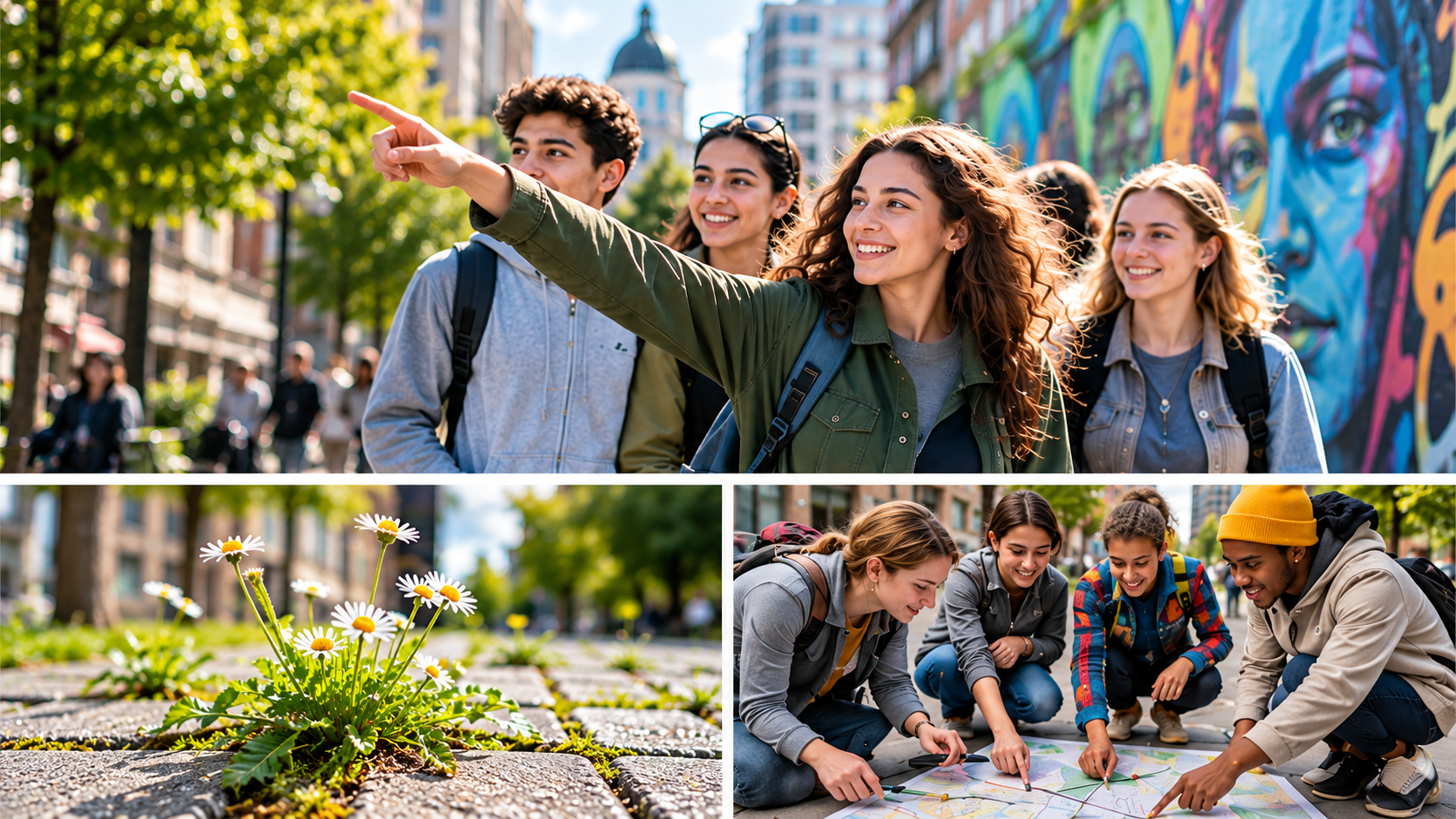
Nature doesn’t stop where the city begins. Sometimes, it grows through the cracks.
When we think about nature, we often imagine forests, mountains, rivers or wide-open countryside. Cities, by contrast, are usually associated with concrete, traffic, buildings and busy streets.
But look a little closer.
A tiny flower pushes through a pavement crack. Birds build nests beneath rooftops. Moss spreads across an old stone wall. Trees create pockets of shade between apartment buildings.
Nature is everywhere in the city. We just don’t always notice it.
At Concrete Jungle, we believe these everyday encounters offer opportunities for outdoor education. By discovering the natural world within urban environments, young people can develop curiosity, environmental awareness and a stronger connection to the places they call home.
The City Is an Ecosystem Too
Urban environments are often presented as the opposite of nature. Yet cities are living ecosystems, shaped by relationships between people, plants, animals, buildings, water and climate.
A single street can contain an extraordinary variety of life.
Trees provide food and shelter for birds and insects. Wildflowers growing in overlooked spaces may support pollinators. Gardens, parks, riversides and even abandoned plots can become important habitats.
Some species adapt remarkably well to urban conditions, while others struggle with pollution, noise, artificial lighting and habitat fragmentation.
Exploring these relationships helps us understand that cities are not separate from the natural world. They are part of it.
The question isn’t simply whether nature exists in cities, but how we can make urban spaces healthier for both people and other living things.
1. Discover the Nature Beneath Your Feet
One of the easiest ways to begin exploring urban biodiversity is to slow down.
Take a walk through a familiar neighbourhood and challenge yourself to notice small signs of life.
Look for plants growing between paving stones, lichens on walls, insects visiting flowers or roots reshaping the pavement.
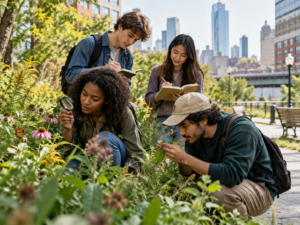
Ask participants to document five examples through photographs, sketches or written observations.
They don’t need to identify every species. The goal is to practise looking carefully and asking questions.
Questions to explore:
- Why might a plant grow successfully in this particular place?
- What conditions does it need to survive?
- How do buildings and human activities influence its environment?
- Would we have noticed it without deliberately looking?
An ordinary pavement can become a starting point for conversations about adaptation, resilience and biodiversity.
2. Follow the Urban Wildlife Trail
Cities are home to many animals, although some are easier to encounter than others.
Birds, butterflies, bees, ants and other small creatures can offer opportunities to observe wildlife in everyday surroundings.
Invite participants to explore a park, courtyard or quiet street and record signs of animal activity.
Instead of approaching animals, observe from a respectful distance. Look for movement, sounds, tracks, nests or evidence of feeding.
Participants could create a simple wildlife map showing where different observations were made.
Afterwards, discuss why certain locations seem more welcoming to wildlife than others.
Does the area contain trees, flowers, water or shelter? Is it busy and noisy? Are green spaces connected, or separated by roads and buildings?
This activity can introduce ideas about habitat quality, biodiversity and the impact of urban planning.
3. Explore the Hidden Green Spaces
Not every valuable natural space looks like a carefully maintained park.
Some of the most interesting places are easy to overlook: an overgrown corner beside a railway, a patch of wildflowers near a car park, an old courtyard or a neglected strip of land.
These spaces can reveal how nature develops when human intervention is limited.
Choose a publicly accessible location where observation is safe and permitted.
Invite participants to examine what is growing there and how the space is used.
Reflection questions:
- Does this place look abandoned, alive, or both?
- Who benefits from leaving some areas less intensively maintained?
- Can a place be valuable even if it looks untidy?
- How might residents feel about this space?
It’s important not to romanticise neglected spaces. Some may contain pollution, broken glass or other hazards. Activities should take place only where conditions have been assessed as safe.
4. Experience the City Through Its Sounds
Nature isn’t only something we see.
It can also be heard.
In a safe, comfortable location, ask participants to pause for a few minutes and listen to their surroundings.
Can they hear birds, leaves moving in the wind or insects? How do these sounds interact with traffic, construction, conversations or public transport?
Participants can create a simple sound map, marking what they hear and where the sounds appear to come from.
Then compare observations.
Some people may notice natural sounds immediately, while others may focus on mechanical or human activity.
Discuss: How does sound influence our experience of a place? What makes an environment feel peaceful, stressful, welcoming or overwhelming?
Offer alternatives for participants who find busy sound environments uncomfortable.
5. Imagine a Greener Neighbourhood
Observation becomes especially powerful when it leads to imagination.
After exploring local examples of urban nature, invite participants to redesign a familiar street, square or neighbourhood.
They might propose more trees, wildlife-friendly planting, accessible green spaces, rain gardens, safer walking routes or community gardens.
Ask them to consider the needs of different residents, including children, older people and people with disabilities.
They can present their ideas through maps, drawings, models or short group presentations.
Encourage realistic thinking alongside creativity: Who would need to be involved? What could be achieved through a small community initiative? What would require decisions from local authorities?
This activity connects environmental learning with civic participation and a sense of agency.
Why Urban Nature Matters for Education
Discovering nature in cities is about more than identifying plants and animals.
It creates opportunities to practise observation, ask questions and develop a sense of responsibility towards shared environments.
Urban nature activities can help participants:
- Understand the relationship between cities and ecosystems.
- Recognise how human choices affect biodiversity.
- Explore environmental inequalities, including unequal access to green spaces.
- Develop curiosity about familiar neighbourhoods.
- Imagine practical improvements to their local environment.
These activities can also make outdoor education more accessible to groups who cannot easily travel to forests, mountains or rural locations.
However, accessibility should never be assumed. Routes, distances, sensory conditions, weather and physical barriers all need to be considered when planning a session.
Nature and Culture Are Not Opposites
One of Concrete Jungle’s core educational themes is Nature vs. Culture / Rural vs. Urban.
The city gives us a particularly interesting place to challenge those divisions.
A tree-lined street combines human planning with natural processes. A community garden connects food, social relationships and biodiversity. A wildflower growing through concrete reminds us that life continues within environments shaped by people.
Perhaps the most important lesson is that nature and culture are constantly interacting.
Cities are not finished systems. They change through the actions of residents, planners, educators, communities and the living organisms that share these spaces.
When young people begin noticing these relationships, they can develop a more thoughtful understanding of the places around them.
Start With One Small Discovery
You don’t need specialist equipment or an elaborate lesson plan to begin.
Choose a familiar urban space. Spend twenty minutes looking more closely. Record what you discover. Share your observations and questions.
The aim isn’t to find something extraordinary.
It’s to recognise the extraordinary things already present in everyday places.
The next time you walk through your city, look down, look up and look between the buildings. Nature might be waiting somewhere you least expect it.
Explore More With Concrete Jungle
Looking for activities that explore biodiversity, environmental awareness and the relationship between people and urban spaces?
Visit the Concrete Jungle Toolkit for educational tools and inspiration you can adapt to your own group.