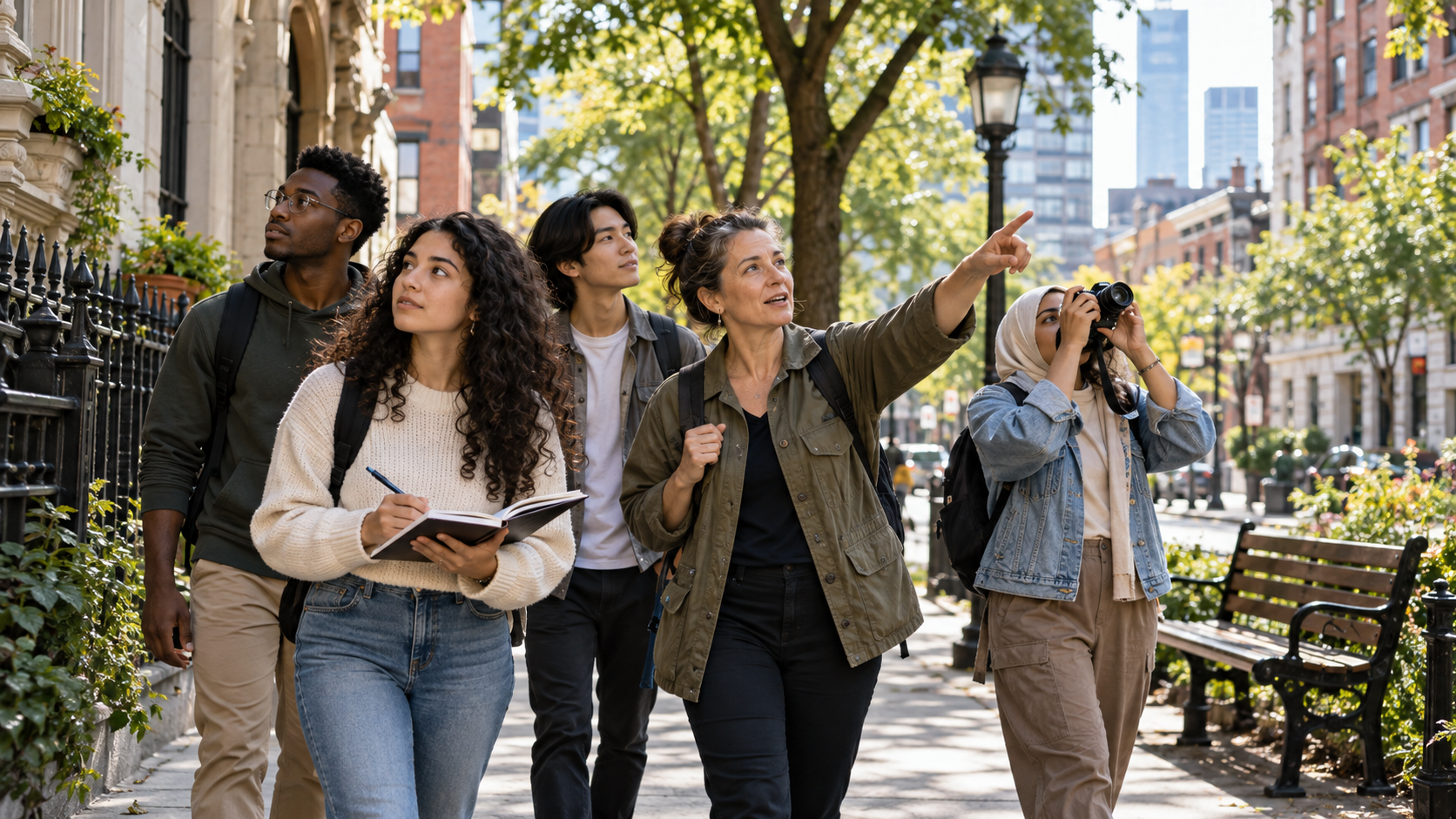
You don’t need a forest, a mountain or expensive equipment to create meaningful outdoor learning experiences. Sometimes, all you need is the city around you.
When we think about outdoor education, we often imagine green landscapes, remote campsites or adventures far from everyday life. But what about the streets we walk along every day? The public squares where people gather? The forgotten corners, buildings, parks and neighbourhoods that shape our communities?
Cities are full of opportunities for exploration, creativity and learning.
At Concrete Jungle, we believe urban spaces can become living classrooms. The city is not simply a backdrop for education; it can be a place where participants observe, question, connect and imagine different possibilities for the future.
Here are seven accessible activities to help you bring outdoor learning into your city.
1. The Urban Nature Hunt
Focus: Nature, observation and environmental awareness
Suggested time: 20–40 minutes
Give participants a simple challenge: find signs of nature in places where they wouldn’t normally expect them.
They might discover plants growing through cracks in pavements, insects around streetlights, trees providing shade or birds nesting on buildings.
Ask participants to photograph or sketch five examples of nature adapting to urban life.
Reflection questions:
- Where did you find the most surprising example of nature?
- How does the city support or restrict living things?
- What could make your neighbourhood more welcoming to wildlife?
This activity encourages participants to see the relationship between nature and urban development differently.
2. Whose City Is This?
Focus: Inclusion, accessibility and the right to the city
Suggested time: 30–60 minutes
Choose a public space, such as a square, park or pedestrian street.
Invite participants to observe who uses the space and how it has been designed.
Are there places to sit? Can people using wheelchairs move around easily? Is there shade? Are there safe places for children to play?
Have participants sketch a simple map showing features that make the space welcoming and features that might exclude people.
Reflection questions:
- Who seems to be considered in the design of this place?
- Who might find it difficult to use?
- What would you change to make it more inclusive?
Encourage participants to make observations rather than assumptions about other people’s experiences.
3. The City Through Five Senses
Focus: Mindfulness, sensory awareness and observation
Suggested time: 15–30 minutes
Find a suitable location where participants can pause safely.
Invite everyone to explore their surroundings through their senses.
What can they see, hear, smell and physically feel? They might notice the sound of traffic, the texture of a wall, the warmth of sunlight or the smell of a nearby bakery.
Participants can record their impressions through words, drawings or short voice notes.
Reflection questions:
- Which details do you normally overlook?
- Which sensations make a place feel comfortable or uncomfortable?
- How might someone else experience the same location differently?
Offer a quieter alternative for participants who find busy sensory environments overwhelming. Never ask participants to taste unknown plants or materials.
4. A Different Kind of City Walk
Focus: Creativity, storytelling and perspective
Suggested time: 45–60 minutes
Instead of following a conventional sightseeing route, give the group a creative theme.
For example:
- Doors and entrances
- Signs of change
- Places where people meet
- Colours of the city
- Hidden beauty
Participants can photograph, sketch or describe three things connected to their chosen theme.
At the end, bring everyone together to share what they discovered.
The same street can generate completely different stories, showing how our experiences shape the way we understand a place.
When taking photographs, respect people’s privacy and obtain permission before making identifiable individuals the subject of an image.
5. Mapping Places of Belonging
Focus: Identity, community and emotional connections to place
Suggested time: 30–45 minutes
Ask participants to draw a simple map of their neighbourhood or another familiar area.
Rather than mapping only streets and buildings, invite them to mark places that feel important.
These might be places where they feel welcome, meet friends, find calm, experience creativity or encounter challenges.
Sharing maps is optional. Participants should never feel pressured to reveal sensitive personal information.
Reflection questions:
- What makes a place feel welcoming?
- Can the same place mean different things to different people?
- How can communities create stronger feelings of belonging?
This activity opens conversations about identity, community and the emotional dimensions of urban life.
6. Reimagine an Everyday Space
Focus: Creativity, participation and imagining alternatives
Suggested time: 45–90 minutes
Choose an ordinary urban location: a bus stop, an empty square, a neglected green space or a school courtyard.
Ask participants to imagine what this space could become if it were redesigned for people, nature and community life.
They can create sketches, collages or short presentations.
Encourage them to think about accessibility, environmental sustainability, safety and the needs of different groups.
Reflection questions:
- What is missing from the space today?
- Who would benefit from your proposed changes?
- Which changes might be achievable through community action?
The goal isn’t to create a perfect design. It’s to show participants that urban spaces are shaped by choices — and that people can help influence those choices.
7. One Small Action for Your City
Focus: Community engagement and turning reflection into action
Suggested time: 30–60 minutes for planning
Finish with a practical challenge.
Invite participants to identify one small action that could improve their local environment.
Ideas might include organising a community conversation, creating an awareness poster, proposing a public-space improvement or planning a neighbourhood clean-up with the appropriate permissions.
Each group develops a simple action plan:
- What would we like to change?
- Why does it matter?
- Who should be involved?
- What is one realistic first step?
End by inviting participants to share what they’ve learned and whether their ideas have changed during the process.
Making Urban Outdoor Education Work for Everyone
You don’t need specialised equipment to begin. Comfortable clothing, paper, pens and a suitable public space are often enough.
However, thoughtful preparation matters.
Before running an activity, consider accessibility, traffic, weather, supervision, local regulations and whether participants feel comfortable in the chosen location. Give people different ways to take part, including options that don’t require extensive walking, photography or public speaking.
Outdoor education works best when activities respond to the needs of the group rather than asking everyone to participate in exactly the same way.
The City Is More Than a Setting
The most powerful learning experiences often begin with a simple question:
What have we never noticed about this place before?
By exploring familiar streets with fresh curiosity, participants can discover environmental connections, question assumptions, understand different perspectives and imagine new possibilities.
Every neighbourhood has stories to tell. Every public space raises questions about how we live together.
And every city has the potential to become a classroom.
Ready to explore?
Visit the Concrete Jungle Toolkit to discover more educational activities and ideas for learning in urban spaces.