Staying by Choice: How Can We Make Rural Areas More Appealing to Young People?
For decades, the story of rural youth has often been told in one direction:
Young people leave.
They move to the city for university, jobs, independence, culture, relationships and opportunity. Some eventually return, but many do not.
It is easy to see this simply as a demographic problem.
But perhaps we should ask a different question.
What would make a young person want to stay?
Not because they have no alternative. Not because they are expected to remain close to family. Not because rural communities need them.
But because staying genuinely feels like a good choice.
Rural life has advantages — but they are not always enough
Rural areas can offer things that many urban residents actively seek: access to nature, stronger community connections, more space, a slower pace of life, lower levels of congestion and opportunities to live close to landscapes and places of environmental value.
Yet these advantages do not automatically translate into a compelling future for young people.
A beautiful landscape does not replace a job.
A strong community does not replace affordable housing.
A village green does not replace reliable internet.
And a quiet life is not necessarily attractive if “quiet” means having nowhere to meet friends.
The challenge is therefore not to romanticise rural life.
It is to understand what young people actually need to build independent, interesting and secure lives.
Opportunity matters
Perhaps the biggest factor is economic opportunity.
Young people need to believe that they can build a career without having to leave.
That does not mean every rural area needs to recreate an urban labour market. In fact, trying to turn rural communities into miniature cities misses the point.
Instead, rural places can build on their own strengths while embracing new forms of work.
Remote and hybrid working can make it possible for some people to live rurally while working for organisations elsewhere. Shared workspaces, reliable broadband and digital infrastructure can help turn this possibility into a practical reality.
At the same time, rural areas can support local entrepreneurship — from agriculture and food production to tourism, creative industries, environmental services, crafts, technology and small businesses.
The goal should be a rural economy that offers different routes into a future, rather than a single definition of success.
Housing is part of the equation
Young people cannot stay somewhere if they cannot afford to live there.
In many rural areas, housing pressures are complicated by limited supply, second homes, holiday lets, high construction costs and a mismatch between the homes available and the homes local people need.
A young person may grow up in a village but discover that, when they want to rent their first flat or buy their first home, there is simply nothing suitable.
If we want young people to stay, we need to think about housing throughout the life course.
Smaller affordable homes.
Rental options.
Starter homes.
Co-housing.
Homes close to services and public transport.
Opportunities for young people to renovate or adapt existing buildings.
Housing policy can easily become disconnected from the question of who a place is actually trying to retain. It shouldn’t.
Rural doesn’t have to mean isolated

Transport is another crucial piece.
If the only realistic way to get around is by car, young people without access to one can become disconnected from education, employment, friends and social life.
This can be particularly significant for teenagers and young adults.
A rural community does not necessarily need an urban-style public transport network. But it does need mobility options that reflect rural realities: demand-responsive transport, community transport, better cycling and walking connections where feasible, reliable connections to nearby towns, and transport designed around actual patterns of life rather than administrative boundaries.
Because a young person’s idea of “being connected” is not simply about getting to work.
It’s being able to see friends.
Go to a concert.
Attend a class.
Play sport.
Get home after an evening out.
Visit another town without needing to ask someone for a lift.
A place can be geographically rural without being socially disconnected.
Give young people places of their own
One of the simplest questions we can ask is:
Where do young people actually go?
If the answer is “nowhere”, that tells us something.
Young people need spaces where they can meet without necessarily spending money.
A sports facility. A youth centre. A workshop. A music space. A café. A community building. A library. A skatepark. A park. A flexible public space.
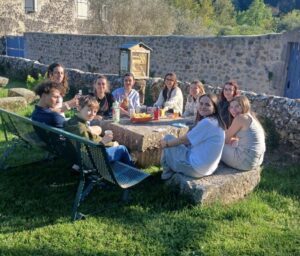
The specific answer will differ from place to place.
What matters is that young people are not treated simply as future residents, future workers or future community volunteers.
They are residents now.
Their social lives, ambitions and interests should be part of the design of rural places today.
Let young people shape the future
Perhaps one of the most powerful ways to retain young people is to give them a meaningful role in deciding what happens next.
Too often, young people are consulted about their communities only when a project is already largely defined.
Instead, they could be involved much earlier.
What would they change?
What do they value?
What would make them stay?
What would bring their friends back?
What spaces are missing?
What kind of businesses would they like to see?
What opportunities would they create themselves?
This is not just about consultation.
It is about ownership.
When young people can see themselves reflected in the future of a place, that place becomes something they can help build rather than somewhere they are simply expected to inherit.
Make rural places exciting in their own way
There is also a danger in framing the challenge as making rural places more like cities.
That is probably the wrong ambition.
Rural communities don’t need to compete with cities on density, nightlife or the number of restaurants within a five-minute walk.
They can compete on something else.
Nature.
Community.
Space.
Quality of life.
Local identity.
Creativity.
Food.
Culture.
Access to the outdoors.
The possibility of having a meaningful role in shaping a smaller community.

The opportunity is to combine these rural strengths with the things young people increasingly expect from contemporary life: connectivity, opportunity, mobility, culture, social spaces and the ability to build an independent future.
Retention isn’t the same as preventing people from leaving
Perhaps the most important shift is in how we think about “retention”.
The objective should not be to stop young people leaving at all costs.
Leaving can be positive. Young people should have the freedom to study, travel, work and experience other places.
The real question is whether leaving is the only route to opportunity — and whether returning is a realistic option.
A young person might leave at 18 and come back at 25.
They might spend ten years elsewhere and return with new skills.
They might work remotely from their childhood village.
They might start a business there.
They might move between rural and urban places throughout their lives.
Rural development should therefore focus not only on preventing outmigration, but on creating a strong enough place that young people can imagine coming back.
Building places people choose
The future of rural communities will not be secured by telling young people that they should stay.
It will be secured by giving them reasons to want to.
That means jobs and entrepreneurship. Affordable and appropriate housing. Reliable digital connectivity. Better mobility. Social and cultural opportunities. Access to education and services. Places to meet. And, above all, a genuine voice in shaping their communities.
The rural future does not have to be a choice between tradition and modernity.
It can be both.
A young person should be able to look at their village, small town or rural community and see not only where they came from, but where they could go.
Staying should be an option. Leaving should be an option. Returning should be an option.
The strongest rural places will be those that make all three possible.